AGENTIC RISK ENGINE
SENTINEL▮
A junior quant risk analyst, automated.
Two lenses on one book. A market-risk engine — VaR, a Fama-French factor model, Markowitz optimization, ML anomaly detection and stress tests. A forensic-accounting engine — fundamentals, DuPont and manipulation screens straight off SEC filings. Then an AI agent reads both and writes the risk memo.
THE PROBLEM
Risk reporting is slow, manual, and backwards-looking.
Every risk desk runs the same loop: pull data, recompute metrics, eyeball charts, write the memo — hours of analyst time producing a report about yesterday. Sentinel automates the loop end to end, across two lenses. On the market side: risk metrics, factor exposure, ML anomaly detection, network structure, stress scenarios and optimization. On the fundamental side: ratios, DuPont and forensic-accounting screens straight off SEC filings. Then the agent reads both and writes the memo, regenerated on demand in minutes.
HOW IT WORKS
One pipeline, from tick data to a written recommendation.
WHAT IT DOES
Two lenses on one portfolio — the markets, and the filings behind them.
Risk & VaR
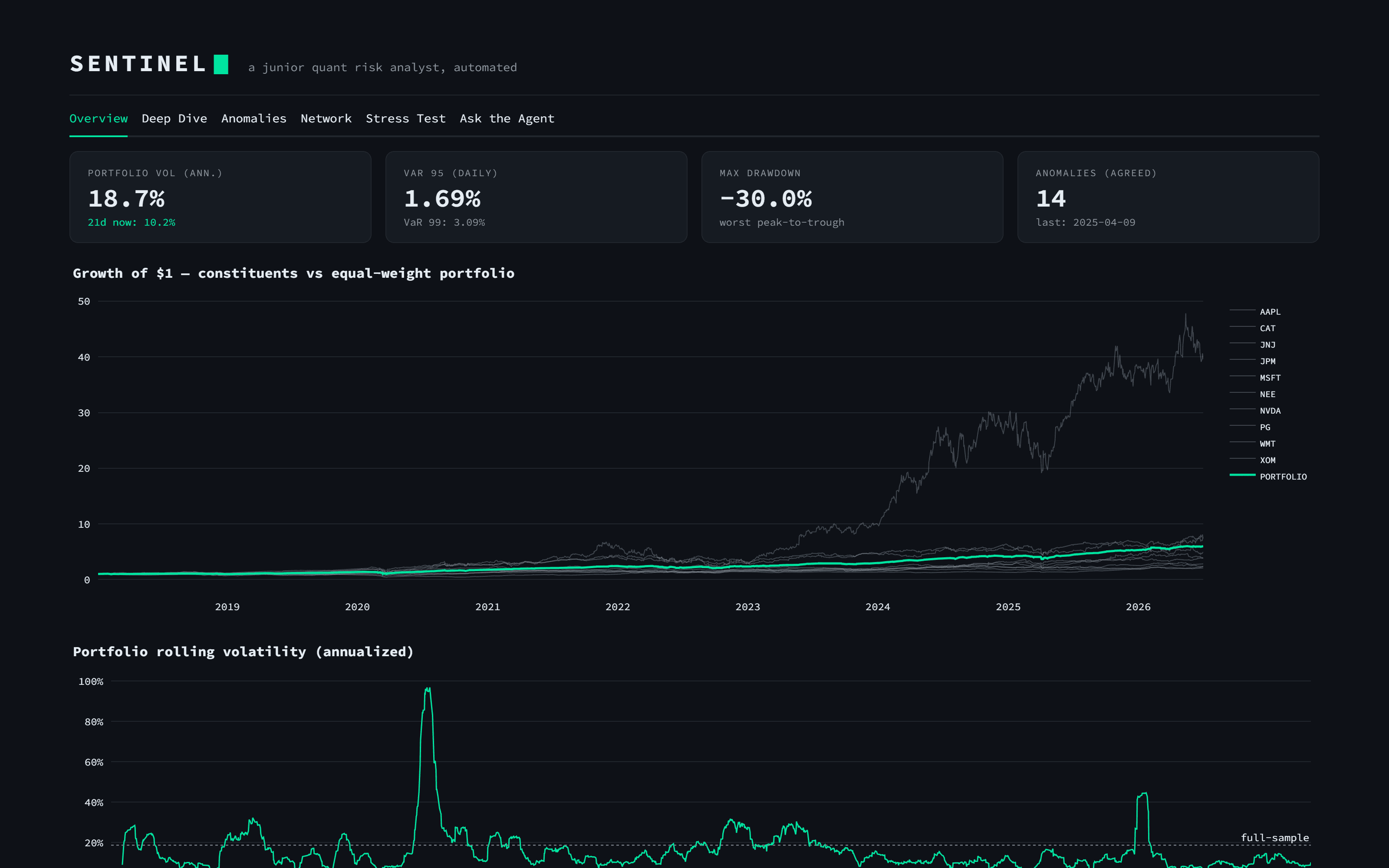
Historical, Gaussian and Cornish-Fisher VaR, Basel expected shortfall, Sharpe/Sortino/Calmar and a Kupiec backtest — the 95% VaR passes out-of-sample (p=0.58).
Factor Model
A Fama-French 6-factor regression on excess returns: R² 0.90, market beta 0.94, and a factor-adjusted alpha of +7.5% (t=3.7) that survives all six factors.
Portfolio Optimization
A Markowitz efficient frontier via long-only SLSQP: max-Sharpe lifts the equal-weight book from 1.01 to 1.18; min-variance cuts vol from 18.7% to 15.5%.
Anomaly Detection
IsolationForest + a PyTorch autoencoder independently rediscovered the COVID crash and the 2025 tariff shock — from raw returns alone.
Stress Testing
Named macro scenarios replayed over history: a 2008-style crash takes daily VaR from 1.7% to 4.6% and the drawdown to −97%.
Network Risk
A correlation network that recovers sectors with zero labels and ranks systemic importance by eigenvector centrality.
Fundamentals & DuPont
SEC EDGAR XBRL → liquidity, solvency and profitability ratios with a 3-step DuPont bridge: Apple's 152% ROE is buyback-shrunk equity; Walmart's 21% is 2.5× asset turnover.
Forensic Screens
Altman Z, Piotroski F, Beneish M, Sloan accruals and Benford's Law — distress and earnings-manipulation screens run straight off the filings, with bank/utility exclusions handled honestly.
AI Risk Memo
An agent with tool access to every model above answers questions and writes the analyst memo — market risk, factor exposure, forensic flags, stress and allocation, then a recommendation.
SHOWCASE
Real outputs, not mockups.
# Sentinel Risk Memo — 2026-07-02

## 2. Market Risk & Factor Exposure
Sharpe 1.01, beta 0.92 vs SPY. Fama-French
alpha +7.5% (t=3.7), R² 0.90 — survives all
six factors. NVDA is 10% of capital, 19% of
portfolio risk.

## 4. Fundamental & Forensic Screens
AAPL ROE 152% — buyback-shrunk equity, not
operating strength. NVDA trips Beneish (M
−1.18): a hypergrowth false positive, not
manipulation.

## 5. Stress Tests & Allocation
2008-style crash: VaR95 1.7% → 4.6%. A
max-Sharpe reweight lifts Sharpe 1.01 → 1.18.

## 6. Recommendation
The binding constraint is the systemic
scenario: sector diversification does not
survive correlated drawdowns...
TECH STACK
Boring tools, deliberately.
- Python
- pandas
- PyTorch
- scikit-learn
- scipy
- NetworkX
- DuckDB
- SEC EDGAR
- FastAPI
- Docker
- Anthropic API
- Streamlit
- Next.js